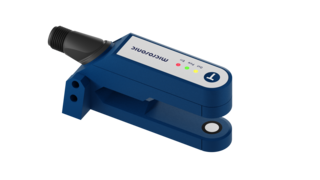
The label sensor reliably detects high-transparency, reflective materials as well as metallised labels and labels of any colour. To do this, labels, together with their backing material (e.g. film or paper), are guided through the sensor fork.
An ultrasonic transmitter in the lower fork leg emits a fast sequence of pulses towards the backing material. The sound pulses cause the backing material to vibrate, resulting in a significantly attenuated sound wave being emitted on the opposite side. The receiver in the upper fork leg detects this sound wave.
As the backing material and the label produce different signal levels, the sensor evaluates this difference and outputs a switching signal – for example, for label positioning, splice detection or web break monitoring. To ensure reliable detection, the sensor is initially learned for the specific label and backing material.