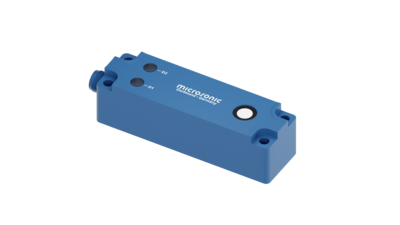
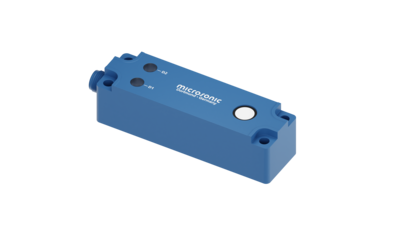
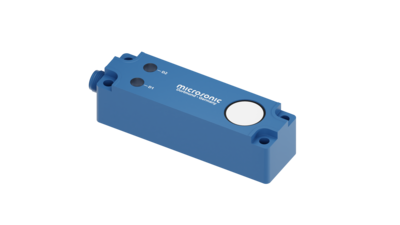
Sensorfamilienbild der lcs Ultraschallsensoren, wo 3 Sensoren der lcs-Reihe zu sehen sind

lcs

Ultrasonic sensors in the lcs series are available in three device variants with three different detection ranges.

Detection ranges:
  • Symbolische Darstellung eines Ultraschallsensor mit einer Tastweite von 0,25 m.0.25 m
  • Symbolische Darstellung eines Ultraschallsensor mit einer Tastweite von 0,35 m.0.35 m
  • Symbolische Darstellung eines Ultraschallsensor mit einer Tastweite von 1,3 m.1.3 m
Outputs:
  • Symbolische Darstellung 2 Schaltausgänge
  • Symbolische Darstellung 3 Schaltausgängen
  • Symbolische Darstellung von einem Analogausgang

Highlights

  • Up to 3 pnp switching outputs
  • Automatic synchronisation for simultaneous operation of up to ten sensors in close quarters

Basics

  • 2 or 3 switching outputs in pnp variant
  • Analogue output 4–20 mA and 0–10 V with automatic switching between current and voltage outputs
  • 3 detection ranges with a measurement range of 30 mm to 2 m
  • microsonic Teach-in on pin 5
  • 0.18 mm resolution
  • Temperature compensation
  • 9–30 V operating voltage
  • LinkControlfor configuration of sensors from a PC

Sensor matrix

The sensor matrix gives an overview of standard sensors from lcs family. Make your choice based on operating range and available outputs and click in the matrix.

The lcs sensors

have a block-like plastic housing with four fixation bores, two of which are already equipped with M4 threaded bushings for eased mounting.

Two or three LEDs

indicate all operating statuses.

Three detection ranges and two output stages are available for selection:

Symbolische Darstellung 2 Schaltausgänge2 pnp switching outputs
Symbolische Darstellung 3 Schaltausgängen3 pnp switching outputs
Symbolische Darstellung von einem Analogausgang1 analogue output 4–20 mA and 0–10 V

Via pin 5 at the M12 circular connector

(Com input), the Ics sensors are set (Teach-in): Switching output D1 is set by connecting pin 5 to +UB, while switching output D2 is set by connecting pin 5 to –UB. Also the sensors with analogue output are set via pin 5.
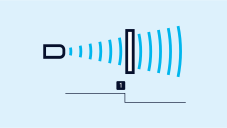
The Ics sensors with switching output offer three operating modes:

  • Single switching point
  • Two-way reflective barrier
  • Window mode

Teach-in of a single switching point

  • Place object to be detected (1) at the desired distance
  • Apply +UB to pin 5 for about 3 seconds
  • Then apply +UB to pin 5 again for about 1 seconds
Teach-in of a switching point
Teach-in of a two-way reflective barrier ultrasonic sensor
Teach-in of a two-way reflective barrier

Teach-in of a two-way reflective barrier

with a fixed reflector

  • Apply +UB to pin 5 for about 3 seconds
  • Then apply +UB to pin 5 again for about 10 seconds

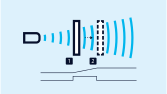
For configuration of a window

  • Place object at the near edge of the window (1)
  • Apply +UB to pin 5 for about 3 seconds
  • Then move the object to the far edge of the window (2)
  • Then apply +UB to pin 5 again for about 1 seconds
Teach-in of an analogue characteristic or a window with two switching points
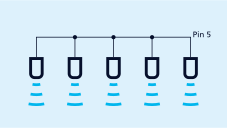
Synchronisation using pin 5
Synchronisation via pin 5

Synchronisation

permits the simultaneous use of multiple mic sensors in an application. To avoid mutual interference, the sensors can be synchronised with one another. To do this, all the sensors are electrically connected on pin 5.

NCC/NOC

and rising/falling analogue characteristic curve can also be set via pin 5.

The analogue sensor

checks the load connected to the output and then automatically switch to 4–20 mA current output or 0–10 V voltage output to ensure maximum ease of handling. 

The Ics-25/DDD is equipped with three pnp switching outputs

which are set with the help of the Link-Control adapter LCA-2. In addition to this “offline” programming, all Ics sensors can also be parameterised on the PC with the LCA-2 and the Link-Control software .
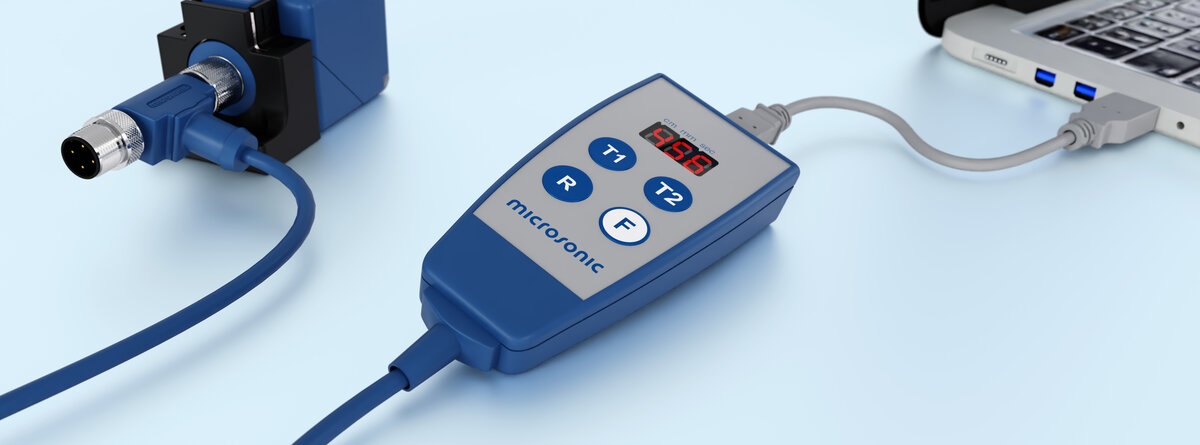
Sensor über LCA-2 für die Programmierung am PC angeschlossen
Sensor connected to the PC via LCA-2 for programming
You have special requirements?
Nothing as simple as that.

With us, you can easily find an individual solution. Let us talk about your application: +49 231 97 51 51-82.