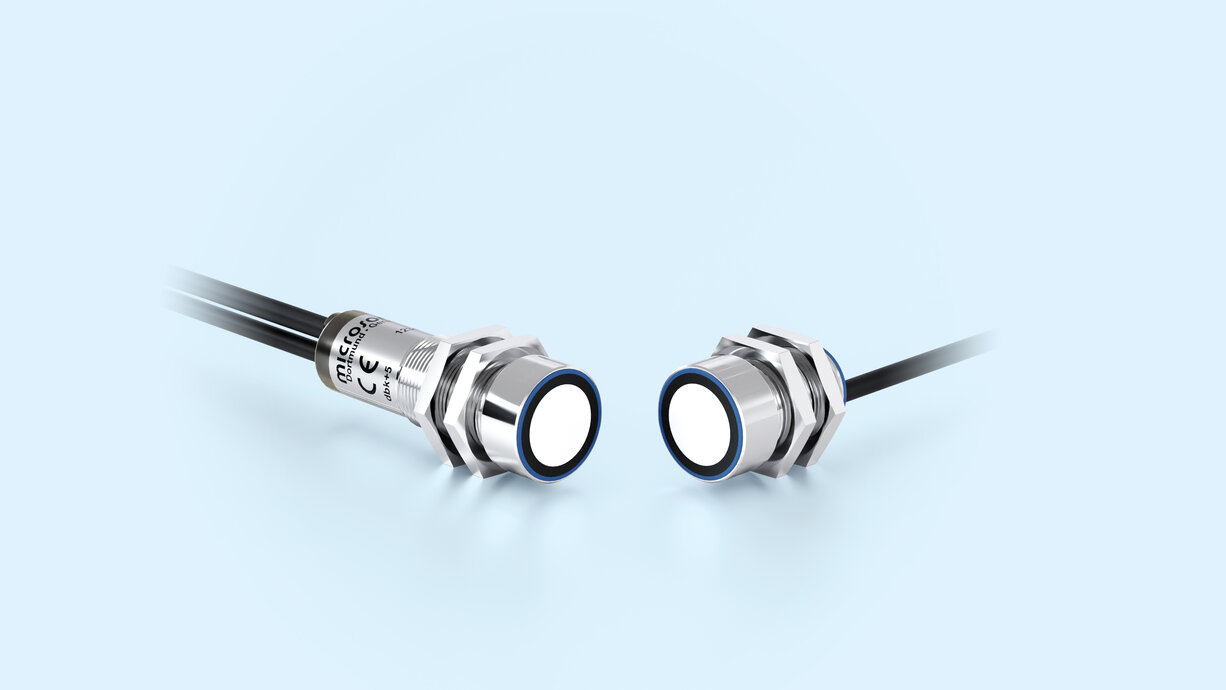






Familienbild wo Sender und Empfänger der Ultraschall-Doppelbogenkontrolle dbk+5 zu sehen ist.

dbk+5 ultrasonic double sheet control

The dbk+5 extends the area of application of double sheet controls to heavy carton, corrugated cardboard, and plastic sheets.

Working range:
  • Symbolische Darstellung Arbeitsabstand zwischen Sender und Empfänger ewsStandard: 20 g/m2 - 1.200 g/m2
  • Symbolische Darstellung Arbeitsabstand zwischen Sender und Empfänger ewsThin: <20 g/m2
  • Symbolische Darstellung Arbeitsabstand zwischen Sender und Empfänger ewsThick: >1.200 g/m2
Outputs:
  • Symbolische Darstellung 2 Schaltausgänge
Housing:

Highlights

  • High-performance ultrasonic double-sheet control especially for the probing of corrugated cardboard as well as plastic 
  • 3 control inputs for Teach-in, trigger, and external sensitivity settings for the material
  • Teach-in option e.g. for probing plates stuck together with an oil film
  • Compact design in M18 x 1 threaded tube

Basics

  • Reliable detection of single and double sheets
  • No Teach-in needed (plug and play)
  • Double-sheet and missing-sheet output
  • Working distance between the transmitter and the receiver selectable from 30 to 70 mm
  • Trigger option for applications in warehouse flow
  • LinkControlfor configuration of sensors from a PC

Sensor matrix

The sensor matrix gives an overview of the entire sensor family. Make your choice based on available sensor compentents and click in the matrix.

The dbk+5 ultrasonic double-sheet control

is designed for scanning thin sheet metal, plastic sheets and corrugated cardboard with thicknesses exceeding the working range of the dbk+4 sensors. The principle behind the operation is the same as for the dbk+4 sensors. The main difference between the systems lies in the materials to the detected. (For further information, see dbk+4.)
Typical materials

in the range of applications of the dbk+5 are sheet metal up to approx. 2 mm thick (depending on the type of metal), plastic sheets and boards for printed circuits up to a thickness of several millimetres, and coarse corrugated card.

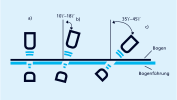
Papers require the sensors to be mounted perpendicular to the passing sheets. But in the case of sheet metal, plastic sheets and boards for printed circuits, it is preferable to mount the dbk+5 at an angle of 10–18° to the passing sheets. The optimum angle should be determined by way of trials. Corrugated cards should be scanned at an angle of 35–45° to the corrugations.

Transmitter and receiver

are housed in M18 x 1 mm threaded sleeves which should be mounted from 30 to 70 mm apart.

Schematische Darstellung von Sender und Empfängeranordung in verschiedenen Winkeln zum Material
You have special requirements?
Nothing as simple as that.

With us, you can easily find an individual solution. Let us talk about your application: +49 231 97 51 51-82.