







Auf dem Foto sind die pico+TF Ultraschall-Füllstandsensoren mit PTFE-Membran in vier verschiedenen Tastweiten zur Füllstandsmessung auf aggressive Medien zu sehen.

pico+TF

The pico+TF sensors are ideal for the non-contact fill level measurement of chemically aggressive liquids or granules.

Detection ranges:
  • Symbolische Darstellung eines Ultraschallsensor mit einer Tastweite von 0,15 m.0.15 m
  • Symbolische Darstellung eines Ultraschallsensor mit einer Tastweite von 0,25 m.0.25 m
  • Symbolische Darstellung eines Ultraschallsensor mit einer Tastweite von 0,35 m.0.35 m
  • Symbolische Darstellung eines Ultraschallsensor mit einer Tastweite von 1,0 m.1.0 m
Outputs:
  • Symbolische Darstellung 1 Push-Pull-Schaltausgang in pnp- und npn-Schaltungstechnik mit IO-Link-Schnittstelle
  • Symbolische Darstellung von einem Analogausgang
Threaded sleeves:

Highlights

  • PTFE membrane for protection against aggressive media
  • M22 sleeve in PVDF
  • IO-Link interface for support of new industry standard
  • Automatic synchronisation and multiplex operation for simultaneous operation of up to ten sensors in close quarters

Basics

  • 1 Push-Pull switching output pnp or npn basis 
  • Analogue output 4–20 mA or 0–10 V
  • 4 detection ranges with a measurement range of 20 mm to 1,300 mm
  • microsonic Teach-in on pin 5
  • 0.069 mm resolution
  • Temperature compensation
  • 10–30 V operating voltage
  • LinkControlfor configuration of sensors from a PC

pico+TF ultrasonic sensors

The compact dimensions of the pico+TF sensors makes them ideal for fill-level measurement in housings of restricted dimensions. The ultrasonic transformer is protected against aggressive media by a PTFE film. The exterior PVDF coating with its M22 x 1.5 external thread seals the ultrasonic transformer from the sensor housing.

The M22 sensors detect in a contactless fashion and are reliable within a measuring range of 20 mm to 1,300 mm. The ultrasonic sensor is the best choice for non-contact fill level measurement with chemically aggressive liquids or granules.

A typical application for these sensor line is the fill level monitoring of aggressive paints and inks such as those used in the digital printing sector. These inks often contain ketone. In addition to the high chemical resistance of the sensor, its size makes it especially suited to use in restricted spaces. Regular filling and emptying of the tank can produce wave motions in the tank system, which can be compensated using the internal filter setting.

For the pico+TF sensor family

there are 2 output stages and 4 detection ranges available:

Symbolische Darstellung 1 Push-Pull-Schaltausgang in pnp- und npn-Schaltungstechnik mit IO-Link-Schnittstelle1 Push-Pull switching output with pnp or npn switching technology with IO-Link interface
Symbolische Darstellung von einem Analogausgang1 analogue output 4–20 mA or 0–10 V
Der pico+TF Ultraschallsensor misst Füllstande von Flüssigkeiten oder Granulaten
The pico+TF ultrasonic sensor continuously detects the fill level of liquids and granules.

Sensors with switching output have three operating modes:

  • Single switching point
  • Two-way reflective barrier
  • Window mode

Teach-in of a single switching point

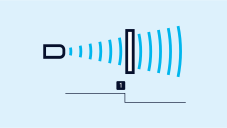
  • Place object to be detected (1) at the desired distance
  • Apply +UB to pin 5 for about 3 seconds
  • Then apply +UB to pin 5 again for about 1 second
Teach-in of a switching point
Teach-in of a two-way reflective barrier ultrasonic sensor
Teach-in of a two-way reflective barrier

Teach-in of a two-way reflective barrier

with a fixed reflector

  • Apply +UB to pin 5 for about 3 seconds
  • Then apply +UB to pin 5 again for about 10 seconds

For configuration of a window

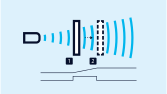
  • Place object at the near edge of the window (1)
  • Apply +UB to pin 5 for about 3 seconds
  • Then move the object to the far edge of the window (2)
  • Then apply +UB to pin 5 again for about 1 seconds

NCC/NOC

and rising/falling analogue characteristic curve can also be set via pin 5.

One green and one yellow LED

indicate the state of the output and support microsonic Teach-in.

Teach-in of an analogue characteristic or a window with two switching points
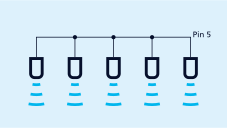
Synchronisation using pin 5

Easy to synchronise

A number of pico+TF sensors can be run closely packed in applications synchronised to stop them from influencing one another. To this end, the sync mode has to be activated and all the sensors are to be electrically connected one to another with pin 5.

If more than 10 sensors must be synchronised, this can be carried out with the SyncBox1 , which is available as an accessory.

In instances of where a number of sensors are run at an IO-Link master, then the master's function is to assume synchronisation.

LinkControl

optionally permits the extensive parameterisation of pico+TF sensors. The LCA-2 LinkControl-Adapter , which is available as an accessory, can be used to connect pico+TF sensors to the PC.

Sensor über LCA-2 für die Programmierung am PC angeschlossen
Sensor connected to the PC via LCA-2 for programming

IO-Link integrated

in version 1.0 for level sensors with switching output.

You have special requirements?
Nothing as simple as that.

With us, you can easily find an individual solution. Let us talk about your application: +49 231 97 51 51-82.